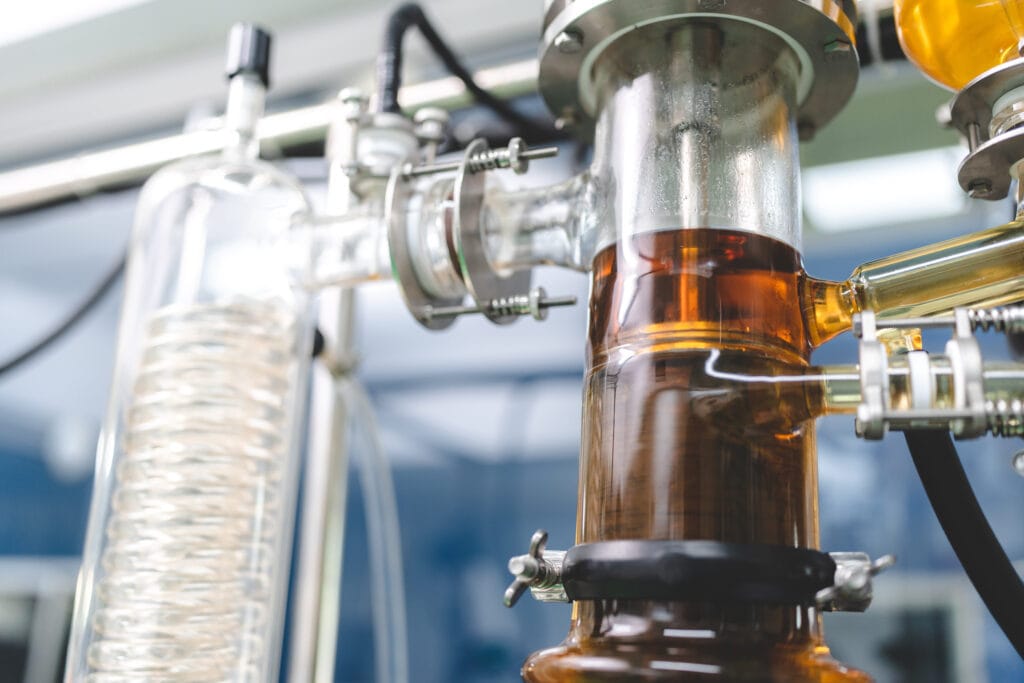
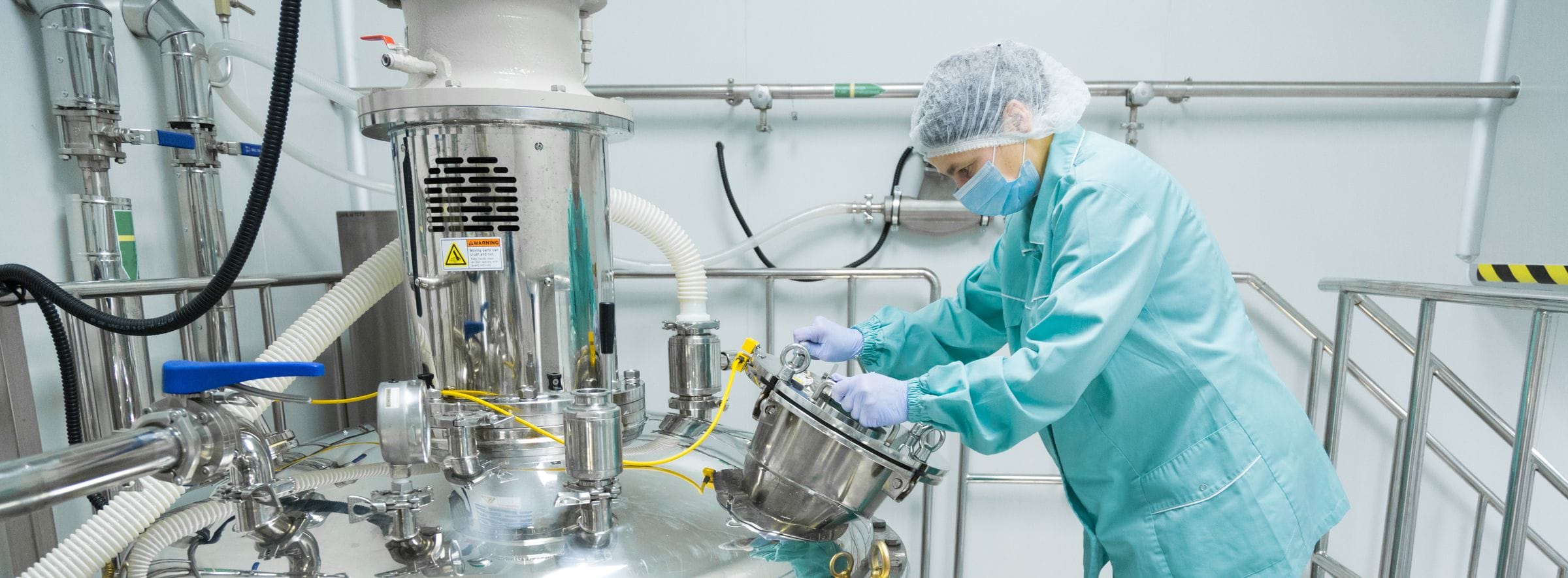
Afriplex has upgraded and expanded its spray drying facility with a custom-designed and custom-manufactured production unit, engineered for the materials that make botanical processing difficult: heat-sensitive actives and volatile components. The expansion widens what we can offer across pharmaceutical, nutraceutical and food applications.
Hot air, cool product
Spray drying looks like a contradiction. Polyphenols, vitamins and many other botanical actives degrade with heat, yet the process introduces a liquid extract into a stream of air heated well above the temperature those molecules tolerate.
The resolution is in the physics. The feed is atomised into droplets small enough that their combined surface area becomes enormous, and evaporation from that surface is close to instantaneous. While free moisture remains, evaporative cooling holds each droplet near the wet-bulb temperature of the surrounding air, far below the inlet temperature. Residence time in the drying chamber is measured in seconds. The water leaves before the heat reaches the active in any meaningful way.
Inlet air commonly runs between 150 and 200 °C, while the outlet temperature that actually governs product quality sits between about 70 and 90 °C. Outlet temperature is the control lever. Setting it low protects thermolabile actives and polyphenol content but leaves more residual moisture and raises the risk of a sticky, poorly flowing powder; setting it high does the reverse. Every material has its own workable window, and finding it is what process development is for. Our unit was specified around that balance.
What carriers do
Few extracts are spray dried on their own. Carriers such as maltodextrins and gum acacia are dissolved into the feed, where they do several jobs at once.
They form the matrix that microencapsulates the active, putting a physical barrier between it and the oxygen, light and moisture that drive degradation. Maltodextrins are selected by dextrose equivalent for this: lower DE grades have longer chains, a higher glass transition temperature and better film-forming behaviour, while higher DE grades dissolve more readily but attract moisture. Gum acacia contributes emulsifying and film-forming properties that maltodextrin alone does not.
Raising the glass transition temperature is the job that decides whether a run succeeds at all. Botanical extracts are rich in low molecular weight sugars and organic acids with very low glass transition temperatures. Left unmodified they soften at drying temperature, stick to the chamber wall and are lost, so carrier selection is often the difference between a powder and a write-off.
Carriers also do standardisation work. By adjusting the ratio of extract to carrier, a natural material whose potency varies from harvest to harvest is brought to a defined, repeatable assay, on the same principle that governs every standardised extract we release. Scanning electron microscopy of the finished powder characterises the particle surface morphology the process is designed to produce.
Beyond simple drying
The same equipment supports work that goes further than moisture removal. Lipophilic actives can be encapsulated using lipid-based and liposomal systems, carried through the drier inside a protective matrix. Poorly soluble actives can be converted into amorphous solid dispersions with polymer carriers, in which the active is held in a disordered state that dissolves more readily than its crystalline form. Taste and odour masking follows from the same physical enclosure that provides the chemical protection.
Where the trade-offs sit
Carriers dilute. A powder standardised to a defined assay with a high carrier load contains proportionally less extract, and the specification has to say so plainly.
The most volatile aroma fractions are partially lost, which matters for flavour applications and rarely for actives. Very high solids loads improve thermal efficiency and yield but can compromise atomisation. And a parameter set developed for one extract will not transfer intact to another, however similar the two look on paper.
Room to do that development work properly is what the expanded facility provides: matching carrier system, solids load, atomisation and temperatures to the specific molecule, then confirming the result analytically before anything is committed to a production run.
What runs through the facility
The capacity serves a broad portfolio. Standardised botanical extracts and polyphenol-rich materials where oxidation resistance matters. Active pharmaceutical ingredients and excipients. Powdered flavours. Instant powder mixtures, supplement powders and effervescent bases. Dry powder formats for specialised applications.
What leaves the facility in each case is a stable, free-flowing powder with a defined assay and a certificate of analysis, produced from a botanical starting point that had none of those properties.
This article describes contract manufacturing capability offered to businesses. It is not directed at consumers and nothing in it is a therapeutic claim or medical advice.