
/ Afriplex® GRT
Africa Concentrated – the treasure of ROOIBOS
Afriplex® GRT is an Active Pharmaceutical Ingredient (API) developed in collaboration with the Biomedical Research and Innovation Platform of the South African Medical Research Council.
Our Product
Afriplex® GRT is an Active Pharmaceutical Ingredient (API) developed in collaboration with the Biomedical Research and Innovation Platform of the South African Medical Research Council. This innovative ingredient is a standardised extract of Aspalathus linearis (green rooibos), produced using controlled extraction processes to preserve its unique polyphenolic profile.
The focal point for its development was to study its potential health benefits, particularly the extract’s potential in supporting the management of metabolic syndrome, type 2 diabetes, cholesterol, and obesity-related complications.
During the research phase, significant emphasis was placed on developing an extraction process that preserves the naturally occurring flavonoid compounds found in Aspalathus linearis (green rooibos). The goal was to maintain the integrity of these bioactive molecules while ensuring optimised concentrations of the functional components in the final product.
This unique extract is standardised on Aspalathin, a dihydrochalcone C-glucoside flavonoid that is characteristic of unfermented rooibos. Aspalathin is recognised for its antioxidant properties and its potential role in metabolic health.
Potential Market Applications of Aspalathin
Aspalathin structure
Metabolic Syndrome
Supports prevention and management of multiple dysfunctions contributing to this condition.
Immune System Support
Provides antioxidant activity that helps reduce oxidative stress.
Cardiovascular Health
Assists in cholesterol regulation and overall cardiac function.
Blood Glucose Control
May help reduce elevated blood glucose levels. Also contributes to reducing and preventing insulin resistance.
Weight Management
Supports optimal lipid storage and metabolism.
Liver Protection
Helps protect against damage associated with lipid imbalance, hyperlipidaemia, and other metabolic syndrome-related symptoms.
Market
According to the World Health Organization (WHO), in 1980 the Global diabetes prevalence among adults was 4.7%, with approximately 108 million people affected. In 2014, this rose to 8.5%, with about 422 million people living with diabetes. (WHO Global Report on Diabetes (2016)). Looking at the WHO Diabetes Fact Sheet (updated 2023), the number of people living with diabetes has continued to rise. In 2021, WHO estimated 537 million adults (20–79 years) globally had diabetes (source: International Diabetes Federation data referenced by WHO).
Diabetes prevalence has been rising more rapidly in middle- and low-income countries. The disease is a major cause of blindness, kidney failure, heart attacks, stroke and lower limb amputation. We have even underestimated the diabetes rate: 347 million adult diabetics in 2008 already exceeded the 285 million estimated for 2010 (Shaw et al., 2009; Danaei et al., 2011).
These epidemics of obesity and diabetes contribute to the development of non-communicable diseases (NCDs), the foremost cause of death globally, leading to more deaths each year than all other diseases combined (WHO, 2012). Cardiovascular disease kills almost double the number of diabetics compared to the general population (Peters et al., 2014).
The complexity of these metabolic diseases makes proper treatment of the underlying causes very difficult. (Tiwari and Rao, 2002).
Metabolic Dysfunction
- Hyperinsulinaemia (normoglycaemia)
- Hypertension
- Insulin resistance
- Dyslipidaemia (↑increased Triglycerides, ↓decreased HDL cholesterol)
Disease progression
Type 2 Diabetes
- Hyper- to hypo-insulinaemia
- Hypertension
- Insulin resistance
- Hyperglycaemia; Hypertriglyceridaemia
- Loss of pancreatic β-cell functional mass
- Hypercholesterolaemia (↓decreased HDL cholesterol)
- Hyperglucagonaemia
- Endothelial dysfunction; Atherosclerotic plaque formation
- Ectopic lipid deposition
Obesity
- Adipocyte hypertrophy and hyperplasia
- ↑increased Inflammation
- Dyslipidaemia (↑increased Triglycerides, ↓decreased HDL cholesterol)
- ↑increased Leptin resistance, ↓decreased Adiponectin
- ↓decreased Satiety signalling
- ↑increased Hepatic lipodysfunction
Figure 1. Schematic illustration of the close relationship between metabolic dysfunction, metabolic syndrome and development of type 2 diabetes. Common to all three are glucose intolerance, lipid dysfunction, inflammation and oxidative stress. [Compiled from Kahn et al. (2014); Kahn et al. (2006)]. Abbreviation: HDL, high density lipoprotein.
Mechanism
The South African Medical Research Council has highlighted the potential of rooibos (Aspalathus linearis) in supporting metabolic health. Preclinical studies have shown that rooibos extracts, particularly those rich in Aspalathin, may help alleviate insulin resistance, enhance glucose uptake, and improve lipid metabolism. These effects have been reported in animal and in vitro models (Kawano et al., 2009; Muller et al., 2012; Kamakura et al., 2014; Mazibuko et al., 2014).
Aspalathin, a unique C-glucosyl dihydrochalcone flavonoid found in unfermented rooibos, has demonstrated antioxidant and anti-inflammatory properties. Research suggests that it can protect pancreatic β-cells against oxidative stress and inflammation, both of which are associated with poor diet, insulin resistance, and obesity (Son et al., 2012; Kamakura et al., 2014; Himpe et al., 2016).
A Japanese study reported that Aspalathin increased glucose uptake and insulin secretion in vitro and was effective in reducing hyperglycaemia and glucose intolerance in diabetic mouse models (Li et al., 2009). These findings suggest potential benefits for glycaemic control, although confirmation in human clinical trials is still limited.
Further research has indicated that rooibos and its bioactive compounds may provide cardioprotective effects in the context of diabetes, including reducing oxidative stress and improving cardiac function (Johnson et al., 2016). Additionally, studies have demonstrated that Aspalathus linearis exhibits potent antioxidant and anti-mutagenic properties, and may possess immune-modulating and chemo-preventive actions (McKay & Blumberg, 2007).
Adipocytes
- ↑increased Apoptosis (via Fas and mitochondrial pathways)
- ↓decreased Adipogenesis (↓decreased GPDH activity)
- ↓decreased Lipid peroxidation (brown adipose)
- ↓decreased Leptin, ↑increased adiponectin
- ↓decreased Proliferation
- ↓decreased Intracellular TG
- ↑increased Glucose uptake (↑increased GLUT4, PI3K)
Blood Plasma and Erythrocytes
- ↓decreased TBARS, H₂O₂
Skeletal Muscle
- ↑increased Glucose uptake (↑increased GLUT4, PI3K, PPARγ)
Liver
- ↓decreased Lipid accumulation (↓decreased FAS, HMGCoA reductase, ACAT)
- ↑increased Glycogen (↑increased GK, normalised G6Pase, ↓decreased PEPCK)
- ↑increased SOD, CAT and GSH-dependent enzymes
- ↓decreased Hepatic lipase
- ↑increased FA β-oxidation
- ↑increased PPARα
- ↓decreased Glucose production
- ↓decreased TBARS, H₂O₂
Gastro-Intestinal Tract
- Inhibition of α-glucosidase and α-amylase
Pancreas
- ↑increased PDX-1 and INS
- ↑increased β-cell number
- ↓decreased Apoptosis
- ↑increased Insulin
- ↑increased Protection against gluco-lipotoxicity
- ↑increased SOD, CAT and GSH-dependent enzymes
Amelioration of hyperglycaemia, oxidative stress, obesity and dyslipidaemia
Figure 2. Overview of the mechanisms of action of Afriplex® GRT on obesity and diabetes. (ACAT, acyl-CoA:cholesterol acyltransferase; CAT, catalase; FA, fatty acids; FAS, fatty acid synthase; GK, glucokinase; GLUT4, glucose transporter 4; G6Pase, glucose-6-phosphatase; GPDH, glycerol-3-phosphate dehydrogenase; GSH, glutathione; HMG-CoA reductase, 3-hydroxy-3-methylglutaryl coenzyme A reductase; INS, insulin gene; PDX-1, pancreatic and duodenal homeobox 1; PEPCK, phosphoenolpyruvate carboxykinase; PI3K, phosphatidylinositol-3-kinase; PPAR, peroxisomal proliferator-activated receptor; SOD, superoxide dismutase; TBARS, thiobarbituric acid reactive substances; TG, triglycerides).
Active Ingredients
Afriplex® GRT is an Active Pharmaceutical Ingredient (API) developed from green Rooibos (Aspalathus linearis). It is specifically enriched in Aspalathin, a flavonoid unique to Rooibos, which is associated with multiple health benefits.
Botanical
Aspalathus linearis grows naturally in the Cederberg region of South Africa’s Western Cape. This hardy, drought-tolerant crop thrives in the area’s sandy soils and Mediterranean climate. The highest quality Rooibos typically comes from higher-altitude regions with lower rainfall, which produce smaller yields but superior flavour and antioxidant profiles.
Geographic indicator
To achieve an optimised and standardised final product, the process begins with sourcing plant material of exceptional quality. Afriplex® GRT was developed by partnering with preselected suppliers and utilising carefully chosen plant material. This approach not only ensures a superior quality outcome but also guarantees complete traceability throughout the supply chain.
ROOIBOS received Geographic Indications (GI) status in July 2014
ROOIBOS received Geographic Indications (GI) status in July 2014 – a status it shares with products such as Port and Champagne. This distinct form of intellectual property (IP) right is recognised by the World Trade Organization and is typically given to products that are produced in a specific way and whose quality and reputation are attributed essentially to their place of origin (Bramley et al, 2014). The Cederberg region provides the perfect environment for ROOIBOS cultivation.
Production
Afriplex® GRT begins with the careful selection of high-quality, sustainably sourced Rooibos raw material. Using a patented process and specialised techniques, we ensure consistent levels of Aspalathin and related active compounds in the final Active Pharmaceutical Ingredient (API). During development, significant focus was placed on preserving the naturally occurring flavonoids found in Rooibos while optimising the concentration of functional components. The result is a standardised API in powder format—designed for integration into both powder and liquid formulations.
Afriplex® GRT Active
Aspalathin, also called dihydrochalcone C-glucoside, is unique to the ROOIBOS plant, Aspalathus linearis. (Muller et al, 2012).
Flavonoid Aspalathin
Developed in collaboration with the MRC’s Diabetes Development Platform, Afriplex® GRT delivers a high Aspalathin content with minimal chlorophyll. This premium API is ideal for pharmaceuticals, complementary medicines, Aspalathin-rich supplements, and a wide range of health applications. The comparison to other ROOIBOS extracts may be seen in the graph below:
The key difference between green and conventional Rooibos lies in processing. Green Rooibos—whether organic, wild-harvested, or conventional—is unoxidised, preserving higher levels of Aspalathin and antioxidants. While Afriplex® GRT uses green Rooibos, it is far more than a simple extract. Our patented process unlocks a full spectrum of actives unique to the plant, delivering a standardised, premium API for advanced health applications.
Pre-clinical Research
Over the years, numerous studies on Aspalathin have been conducted both locally and internationally. While many of these investigations have reported positive outcomes, it is important to note that current and ongoing studies have demonstrated conclusive results specifically using the Active Pharmaceutical Ingredient (API), Afriplex® GRT.
The primary objective in developing Afriplex® GRT was to harness its potential health benefits for individuals managing the symptoms and complications associated with metabolic syndrome, including diabetes, insulin resistance, cholesterol issues, and obesity.
The work and research performed by the SAMRC indicates that Afriplex® GRT has a positive influence on the regulation of cholesterol, blood glucose level maintenance and insulin resistance. An additional advantage of using Afriplex® GRT is its ability to function as an immune booster.
Anti-diabetic and hypoglycaemic effects of aspalathin-enriched rooibos extracts (Fig 1) demonstrate the inhibition of α-glucosidase by aspalathin, as a mechanism to slow gastric glucose uptake and modulate post-prandial blood glucose levels.
Adapted from Muller CJF, et al. Acute assessment of an aspalathin-enriched green rooibos (Aspalathus linearis) extract with hypoglycemic potential. Phytomedicine 2012;20(1):32–39, with permission from Elsevier.
Fig 2. Aspalathin-enriched green rooibos extract increases glucose uptake and utilisation by muscle cells.
Adapted from Muller CJF, et al. Acute assessment of an aspalathin-enriched green rooibos (Aspalathus linearis) extract with hypoglycemic potential. Phytomedicine 2012;20(1):32–39, with permission from Elsevier.
Fig 3. Aspalathin-enriched green rooibos extract improves glucose tolerance in diabetic rats.
Adapted from Muller CJF, et al. Acute assessment of an aspalathin-enriched green rooibos (Aspalathus linearis) extract with hypoglycemic potential. Phytomedicine 2012;20(1):32–39, with permission from Elsevier.
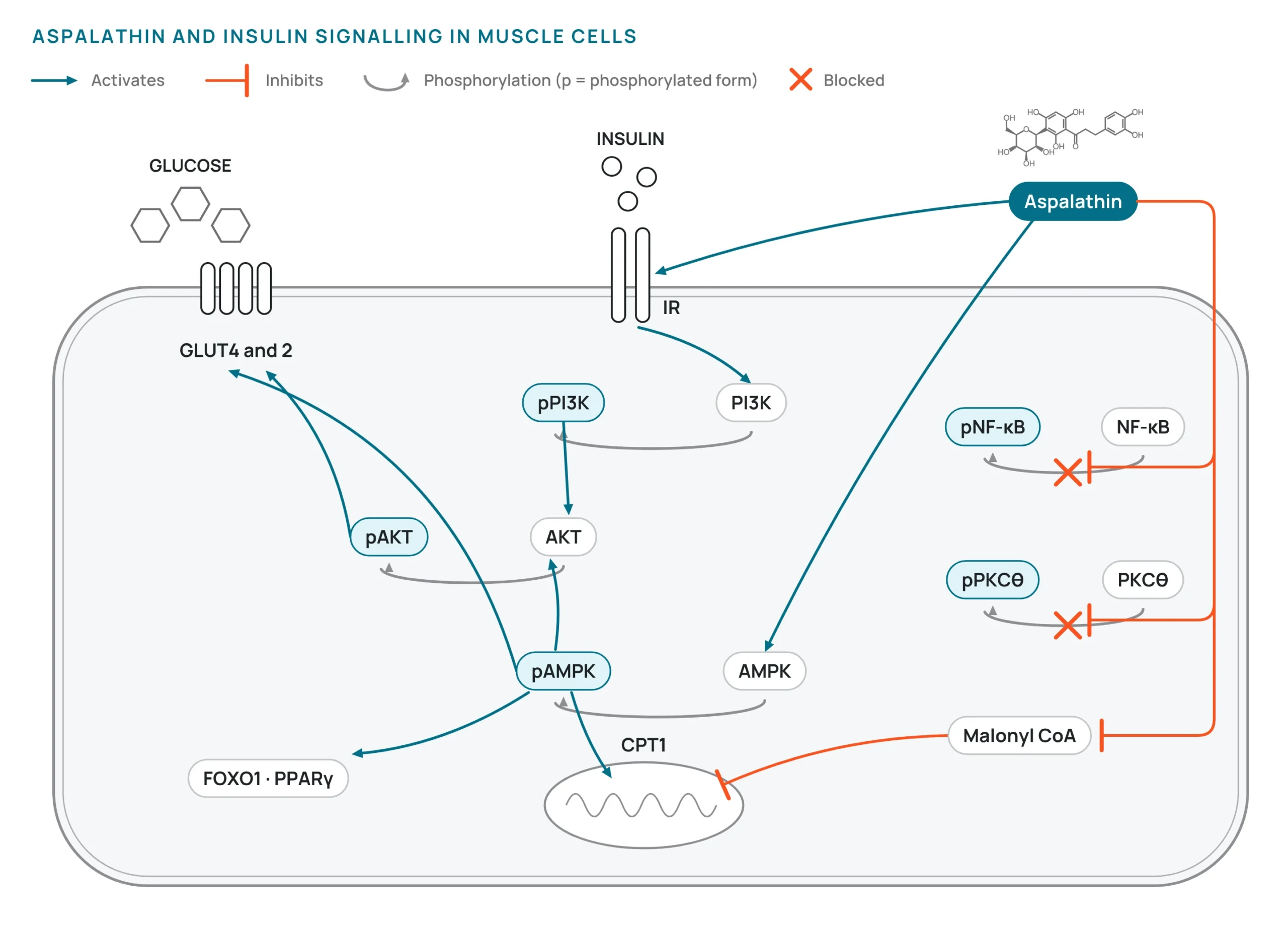
Aspalathin-enriched rooibos extracts ameliorate experimentally induced insulin resistance by improving glucose uptake and fatty acid utilisation in muscle cells. Mechanistically, the aspalathin-enriched green rooibos extract activates and alters the expression of several important biochemical signalling proteins such as AMPK, Malonyl CoA and CPT1, as summarised in the schematic (Fig 9) (Mazibuko et al., 2013).
Fig 9 adapted from Mazibuko SE, et al. Amelioration of palmitate-induced insulin resistance in C2C12 muscle cells by rooibos (Aspalathus linearis). Phytomedicine 2013;20(10):813–819, with permission from Elsevier.
Studies on rats
Preclinical studies by Kamakura and Muller et al. (2012) demonstrated that Afriplex® GRT possesses significant hypoglycaemic potential. In SSTX-induced diabetic rat models, a single oral dose of Afriplex® GRT produced a reduction in blood glucose levels over a six-hour period that was comparable to metformin, a widely used first-line treatment for type 2 diabetes. These findings suggest that Afriplex® GRT may offer a natural alternative or adjunct to conventional therapies for managing hyperglycaemia.
Studies on Non-human primates
Ahead of human trials, Afriplex® GRT underwent rigorous safety and efficacy testing in both healthy and metabolically compromised Vervet monkeys. Results demonstrated an improvement in glucose tolerance among diabetic models, confirming its potential for glycaemic control. Additional analyses revealed that Afriplex® GRT also supports lipid balance and improves cholesterol regulation—key factors in lowering cardiovascular risk. These findings position Afriplex® GRT as a scientifically validated, plant-derived solution for comprehensive metabolic health.
Human study
A randomised, double-blind, placebo-controlled clinical trial has been designed to evaluate Afriplex® GRT in obese men and women over a six-week intervention. Participants will undergo comprehensive physiological assessments before and after treatment. The study will also focus on oxidative stress markers to provide deeper insight into Afriplex® GRT’s role in metabolic health. This pivotal trial represents a significant step toward validating Afriplex® GRT as a scientifically proven, plant-derived solution for managing obesity-related complications.
Reference Library
- Orlando, P., Chellan, N., Louw, J., Tiano, L., Cirilli, I., Dludla, P., Joubert, E., & Muller, C. J. F. (2019). Aspalathin-rich green rooibos extract lowers LDL-cholesterol and oxidative status in high-fat diet-induced diabetic vervet monkeys. Molecules, 24(9), 1713. doi.org/10.3390/molecules24091713
- Himpe, E., Cunha, D. A., Song, I., Bugliani, M., Marchetti, P., Cnop, M., & Bouwens, L. (2016). Phenylpropenoic acid glucoside from rooibos protects pancreatic beta cells against cell death induced by acute injury. PLOS ONE, 11(6), e0157604. doi.org/10.1371/journal.pone.0157604
- Kawano, A., Nakamura, H., Hata, S., Minakawa, M., Miura, Y., & Yagasaki, K. (2009). Hypoglycemic effect of aspalathin, a rooibos tea component from Aspalathus linearis, in type 2 diabetic model db/db mice. Phytomedicine, 16(5), 437–443. doi.org/10.1016/j.phymed.2008.11.009
- Mazibuko, S. E. (2014). In vitro and in vivo effect of Aspalathus linearis and its major polyphenols on carbohydrate and lipid metabolism in insulin resistant models hdl.handle.net/10530/1319
- Muller, C. J. F., Malherbe, C. J., Chellan, N., Yagasaki, K., Miura, Y., & Joubert, E. (2018). Potential of rooibos, its major C-glucosyl flavonoids, and Z-2-(β-D-glucopyranosyloxy)-3-phenylpropenoic acid in prevention of metabolic syndrome. Critical Reviews in Food Science and Nutrition, 58(2), 227–246. doi.org/10.1080/10408398.2016.1157568
- Muller, C. J. F., Joubert, E., de Beer, D., Sanderson, M., Malherbe, C. J., Fey, S. J., & Louw, J. (2012). Acute assessment of an aspalathin-enriched green rooibos (Aspalathus linearis) extract with hypoglycemic potential. Phytomedicine, 20(1), 32–39. doi.org/10.1016/j.phymed.2012.09.010
- Son, M. J., Minakawa, M., Miura, Y., & Yagasaki, K. (2013). Aspalathin improves hyperglycemia and glucose intolerance in obese diabetic ob/ob mice. European Journal of Nutrition, 52(6), 1607–1619. doi.org/10.1007/s00394-012-0466-6
- Johnson, R., Dludla, P., Joubert, E., February, F., Mazibuko, S., Ghoor, S., Muller, C., & Louw, J. (2016). Aspalathin, a dihydrochalcone C-glucoside, protects H9c2 cardiomyocytes against high glucose induced shifts in substrate preference and apoptosis. Molecular Nutrition & Food Research, 60(4), 922–934. doi.org/10.1002/mnfr.201500656
- Kamakura, R., Son, M. J., de Beer, D., Joubert, E., Miura, Y., & Yagasaki, K. (2015). Antidiabetic effect of green rooibos (Aspalathus linearis) extract in cultured cells and type 2 diabetic model KK-Ay mice. Cytotechnology, 67(4), 699–710. doi.org/10.1007/s10616-014-9816-y
- Mazibuko, S. E., Muller, C. J. F., Joubert, E., de Beer, D., Johnson, R., Opoku, A. R., & Louw, J. (2013). Amelioration of palmitate-induced insulin resistance in C2C12 muscle cells by rooibos (Aspalathus linearis). Phytomedicine, 20(10), 813–819. doi.org/10.1016/j.phymed.2013.03.018
- McKay, D. L., & Blumberg, J. B. (2007). A review of the bioactivity of South African herbal teas: rooibos (Aspalathus linearis) and honeybush (Cyclopia intermedia). Phytotherapy Research, 21(1), 1–16. doi.org/10.1002/ptr.1992