Afriplex has developed the capability to extract, purify and crystallise cannabidiol to isolate grade from locally cultivated cannabis, working in partnership with the Cannabis Research Institute (CRI). Manufacturers here have generally imported material at this level of purity.
What isolate grade means
Cannabis extracts sit on a scale of refinement. A crude extract carries the plant’s full cannabinoid profile along with terpenes, waxes, chlorophyll and pigments. A distillate concentrates the cannabinoid fraction but is still a mixture. An isolate is a single cannabinoid, separated from everything else and supplied as a white crystalline powder at purities above 99%. At that last step the material stops behaving like a botanical extract and starts behaving like any other pharmaceutical active, with an assay, a specification and a certificate of analysis.
Several things change for the formulator at once. Dosing becomes arithmetic, because potency is no longer diluted by co-extracted material in unknown proportion. Sensory work gets easier, since the waxes and volatiles that carry bitterness and aroma have gone with the impurities. And tetrahydrocannabinol (THC) can be brought below the limit of detection of a validated method, which is what a THC-free claim ultimately rests on.
The separation sequence
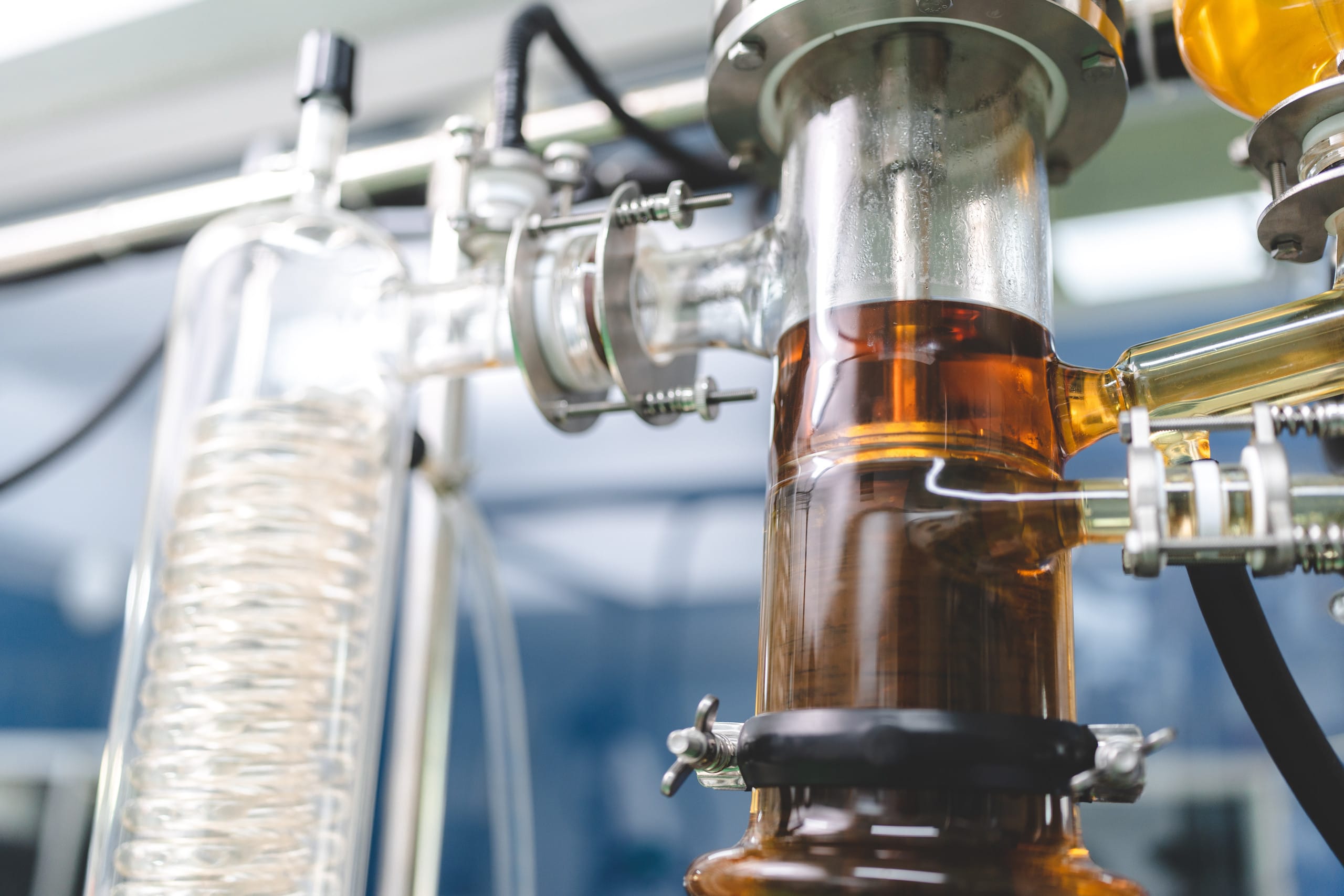
Extraction pulls the cannabinoid fraction from milled biomass using either supercritical carbon dioxide or ethanol. Decarboxylation converts CBDA, the acid form the plant actually produces, into CBD; the mass conversion factor is 0.877, which matters as soon as input assays are reconciled against output yield. Winterisation follows. The extract is dissolved in cold ethanol and held below zero so that fats, waxes and lipids precipitate out, the solids are filtered off, and the solvent is recovered under vacuum. Wiped-film or short-path distillation then concentrates what remains into a refined fraction, typically 70% to 90% cannabinoid content.
Crystallisation does the final work. Dissolved in a non-polar solvent such as pentane or heptane and cooled under controlled agitation, CBD orders itself into a lattice that excludes impurities. The crystals are recovered, washed with cold solvent and dried. Where trace THC survives the sequence, chromatographic remediation takes it out.
None of this is novel chemistry. Crystallisation has been a purification technique in pharmacy for centuries, and the hard part is reproducibility. Cooling rate, agitation, solvent ratio and seeding behaviour all have to be held steady enough that the fortieth batch matches the first, under a quality system, with analytical evidence at each stage.
Reading a certificate of analysis
An isolate certificate should carry the CBD assay and the method used to obtain it, THC content against a declared limit of quantitation, residual solvents by headspace gas chromatography, heavy metals by ICP-MS, microbiological limits, water content and appearance.
The THC line repays attention. A result of “not detected” means little without the detection limit that produced it, and those limits vary between laboratories by an order of magnitude. A manufacturer formulating against a 0,001% threshold needs to know the method could actually see 0,001%, which means asking for the validation summary and not only the result.
Cannabinoid content in our laboratory is determined by high-performance liquid chromatography, which separates the acidic and neutral forms of each cannabinoid without applying heat to the sample.
Purity as a regulatory instrument
Under the schedules to the Medicines and Related Substances Act as amended in May 2020, processed products containing no more than 0,001% THC fall outside Schedule 6. CBD preparations reach Schedule 0 only within defined limits: a maximum daily dose of 20 mg, no more than 600 mg in a sales pack, and claims confined to the gazetted low-risk categories of general health enhancement, health maintenance or relief of minor symptoms. Beyond those limits CBD is a Schedule 4 substance.
Export markets set their own conditions, and they tend to ask the same three questions. How pure is the material, how much THC does it contain, and where did the CBD come from? An isolate with a defined assay and a documented THC method answers all three from a single document.
Why local production matters
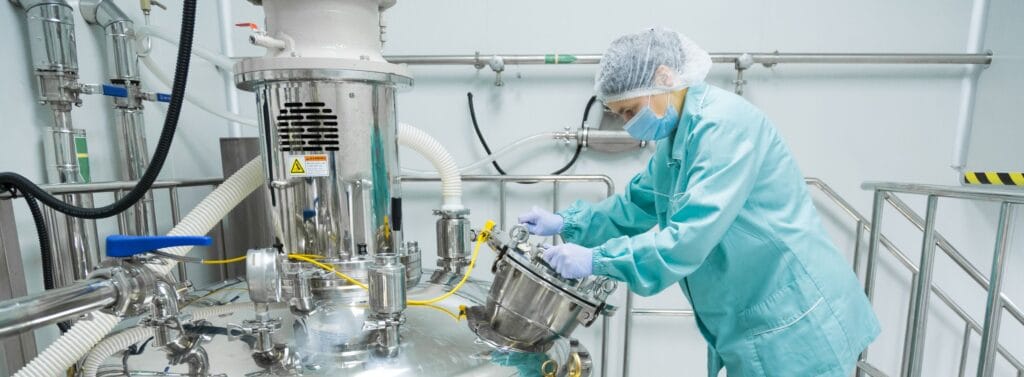
Producing isolate here changes the practical economics of quality. Release testing happens in-country, a deviation can be investigated at its source instead of across an ocean and a time zone, lead times shorten, and the value created stays in the local economy.
Arno Roux, CEO of Afriplex, said that in partnership with the CRI the team had “managed to extract and crystallise CBD from locally sourced material”.
The route from cultivated plant to released, pharmaceutical-grade isolate now runs end to end inside the country.
cannabinoid regulation continues to move. Readers formulating for export should confirm current requirements per destination market, including the European Food Safety Authority’s provisional intake guidance for CBD and the redefinition of hemp limits in United States federal law taking effect in late 2026. The South African scheduling position described above remains in force at the time of this note.
This article describes ingredient manufacturing capability offered to licensed businesses. It is not directed at consumers and nothing in it is a therapeutic claim, medical advice, or an offer of cannabis-containing products to the public. CBD-containing medicines outside the gazetted scheduling exclusions are prescription substances in South Africa. Regulatory classification varies by country.