After reading this you will know which baobab material suits your format, what the EU novel food authorisation and the US GRAS notice actually cover, how to work out whether a vitamin C claim is available, and what to ask about wild harvest.
Baobab pulp dries on the tree, which is why the powder is a simple material to specify
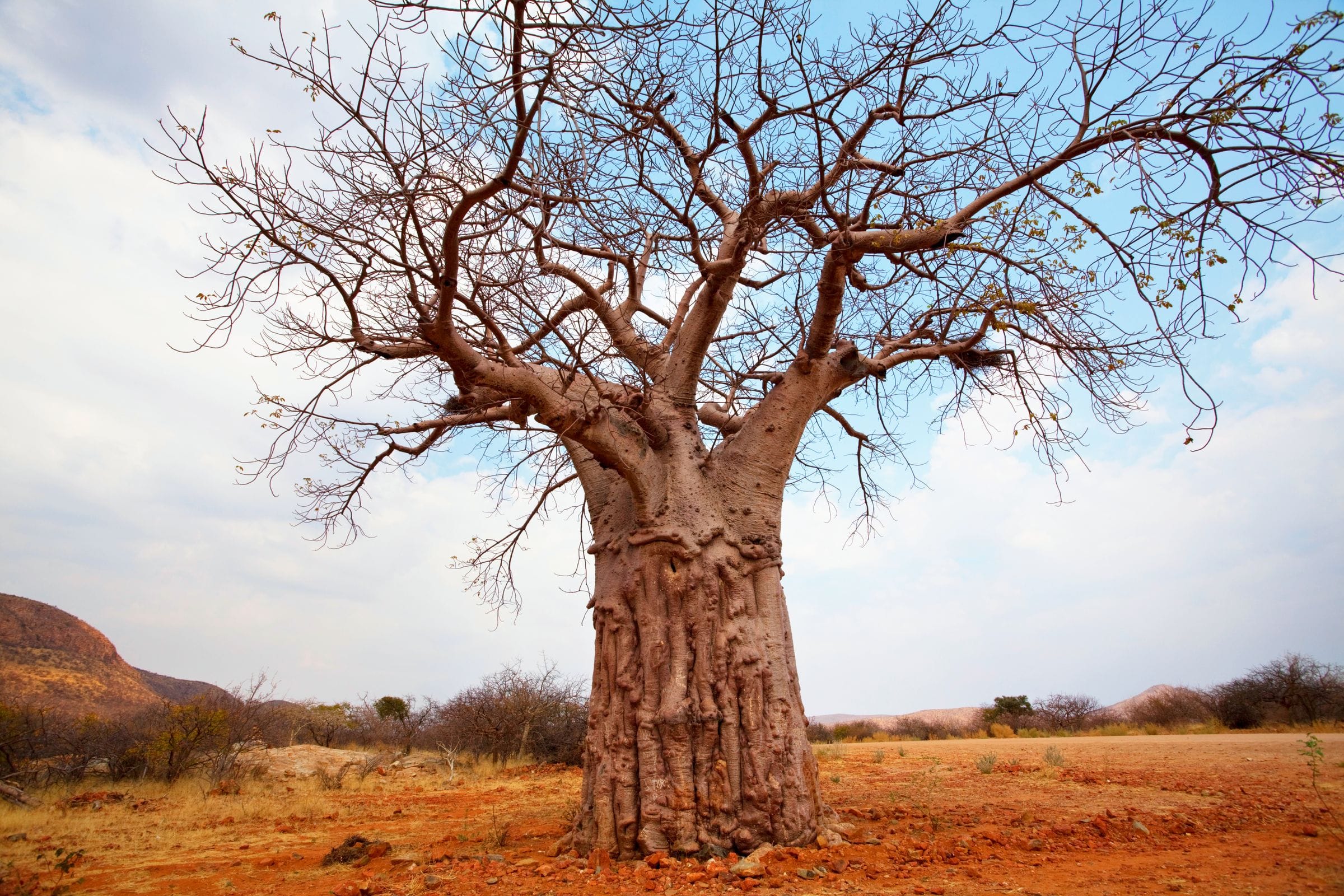
Adansonia digitata is the African savanna baobab. Its fruit pulp dries naturally inside a woody pod while still on the tree, so processing is short: the pod is cracked, the pulp is separated from the seeds and fibre, and the pulp is milled. The seeds are a second raw material, pressed for oil.
For a brand owner that means two purchases from one fruit. Baobab powder is a food ingredient bought on composition, particle size and moisture. Baobab oil is a cosmetic raw material bought on fatty acid profile, oxidative stability and documentation. They sit under different rules and are best specified separately. If you want the background on the plant itself, our news article “Baobab, Adansonia digitata: an African botanical ingredient profile” covers composition and origin in more depth.
Your format decides which baobab material you need
Full fruit pulp powder brings acidity, a sherbet-like flavour and a large soluble fibre fraction, much of it pectin. That fibre is useful in bars, cereals, snacks, yoghurt and dairy desserts, where it adds body. It is a problem in clear beverages, where it adds viscosity and haze.
For a clear drink, ask about a depectinised extract, in which the pectin fraction is reduced so the material disperses without thickening. For smoothies, jams, bakery and dairy, full pulp powder is usually the practical choice. In every case, trial the material in your own matrix and at your own pH, because inclusion rate, water activity and processing heat all change how baobab behaves.
The powder has an EU novel food authorisation and a US GRAS notice
Baobab dried fruit pulp was authorised as a novel food ingredient in the European Union by Commission Decision 2008/575/EC of 27 June 2008. The decision describes the process, sets compositional ranges and limits for moisture, ash and foreign matter, and requires the designation “Baobab fruit pulp” on the labelling of foods containing it. The authorisation is now carried in the Union list of novel foods under Commission Implementing Regulation (EU) 2017/2470 with the same designation.
In the United States, FDA responded to GRAS Notice No. 273 for baobab dried fruit pulp on 25 July 2009 with a “no questions” letter. The notified uses were blended fruit drinks at up to 10 per cent and fruit cereal bars at up to 15 per cent, with lower levels in some other foods.
The practical point is that both positions were granted to baobab fruit pulp as described. Ask your supplier to confirm, in writing, that the material matches the authorised description and specification, and check that your product falls within the notified uses if you rely on the US notice. A depectinised extract or other fraction is a further processing step, so confirm its status separately.
Vitamin C on the label is a matter of arithmetic, not a benefit statement
Dried baobab pulp is commonly reported at roughly 150 to 300 mg of vitamin C per 100 g, and the range moves with origin, season and processing. Whether a finished product can carry a nutrition claim depends on how much of that survives into the pack.
In the European Union a “source of vitamin C” claim under Regulation (EC) No 1924/2006 requires at least a significant amount, defined in Annex XIII of Regulation (EU) No 1169/2011 as 15 per cent of the nutrient reference value per 100 g, or 7.5 per cent per 100 ml for beverages. With a reference value of 80 mg, that is 12 mg per 100 g of a solid food and 6 mg per 100 ml of a drink. A “high” claim needs twice that.
Worked through, baobab at 150 mg per 100 g reaches 12 mg per 100 g at an 8 per cent inclusion, and baobab at 300 mg reaches it at 4 per cent, before any loss. In a drink, 6 mg per 100 ml needs 2 to 4 g of baobab per 100 ml. Vitamin C is sensitive to heat, oxygen and light, so the claim has to be supported by analysis of the finished product at the end of its shelf life, not by the ingredient certificate. In the United States a “good source” claim needs 10 to 19 per cent of the 90 mg daily value per reference amount customarily consumed.
Baobab oil is a cosmetic raw material with its own rulebook
Baobab seed oil is listed in the EU cosmetic ingredient database, CosIng, under the INCI name Adansonia Digitata Seed Oil, with emollient, skin conditioning and hair conditioning functions. In cosmetics it is used as a carrier oil in face oils, balms, hair care and emulsions.
Under Regulation (EC) No 1223/2009 the obligations sit with the responsible person for the finished product: a safety assessment, a product information file, notification before sale, and claims that meet the common criteria. What you need from the oil supplier is what feeds those documents: a specification with fatty acid profile, acid and peroxide values, a certificate of analysis per batch, and the data your safety assessor asks for. Cold-pressed oil should be stored cool and protected from oxygen, and your stability programme should track rancidity markers.
Wild harvest makes traceability part of the purchase
Baobab is not a plantation crop. Fruit is collected from wild trees, many of them centuries old, largely by rural communities across the African savanna. That makes sourcing a documentary question as well as a quality one.
Ask for the collection records held against the lot and for the supplier’s sourcing policy, and keep both on file with the specification.
Questions brand owners ask
Is baobab powder a novel food in the EU?
Yes. Baobab dried fruit pulp has been authorised since 2008 and sits on the Union list. Material that matches the authorised description and specification can be used without a fresh application.
Can I print “source of vitamin C”?
Only if the finished product meets the significant-amount threshold at the end of shelf life, as shown by analysis of the product itself. The vitamin C figure on an ingredient certificate does not establish that.
Will baobab powder cloud my drink?
Full pulp powder usually will, because of its pectin. A depectinised grade is the material to trial for clear beverages.
What should go into the purchase specification?
Plant part, process description, moisture, ash, particle size, microbiological limits, heavy metals, pesticide residues and, if you plan a claim, vitamin C with its test method and a range rather than a single figure.
Is the oil approved for cosmetics?
The EU has no approval list for ordinary cosmetic ingredients of this kind. The oil has an INCI name, and the safety of the finished product rests on the responsible person’s safety assessment.
How Afriplex supplies baobab
We supply baobab as Baobab Pulp Powder for food and beverage formulation, as a depectinised extract and as pectin-rich fractions, and as Afriplex® Baobab Oil, a cold-pressed seed oil for cosmetic use. Our Baobab Pulp Powder meets the EU novel food specification for baobab dried fruit pulp, and we confirm this in writing. Material is released against a certificate of analysis, and specifications are available on request. Our SAHPRA-licensed laboratory in Paarl carries out method development, validation, release and stability testing, and we manufacture finished formats in-house, including powders, sachets, teas and topicals.
This article describes a botanical ingredient supplied to businesses for formulation. It is not directed at consumers, it does not describe a finished product, and nothing in it is a therapeutic claim or medical advice. Regulatory classification varies by country.