After reading this you will know why senna is bought through the medicines channel, how sennoside content is specified and assayed, why its position in food law is a separate question, and what an API buyer should ask for.
Senna is a legume leaf and pod traded under several botanical names
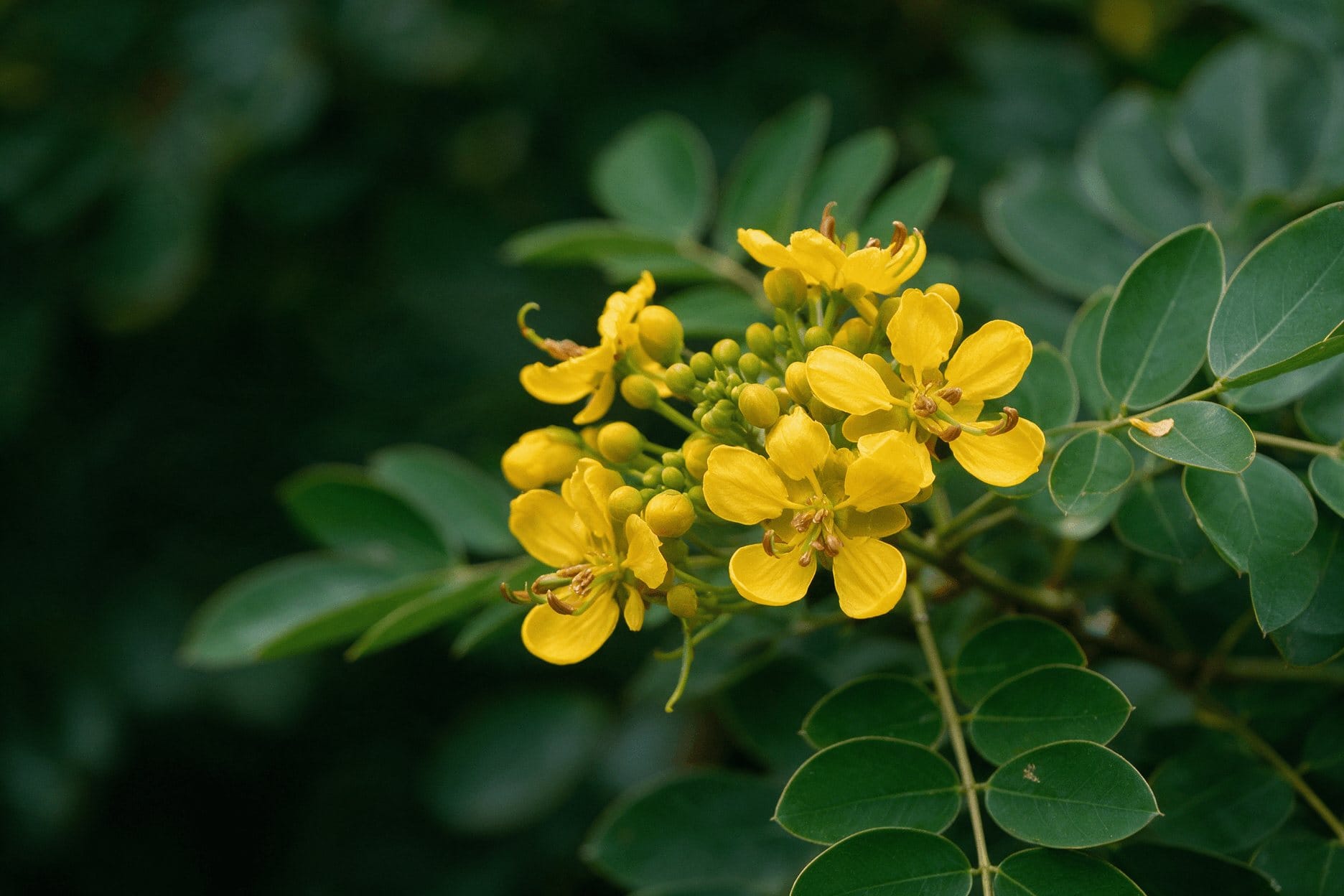
Senna is the dried leaflet and the dried fruit, or pod, of Senna alexandrina Mill., a shrub of the Fabaceae native from the Sahara and Sahel to the Indian subcontinent. Older names remain in regulatory texts: Cassia senna L. and Cassia acutifolia Delile for Alexandrian senna, and Cassia angustifolia Vahl for Tinnevelly senna. The European herbal monographs treat all of them as one species.
The characteristic constituents are hydroxyanthracene glycosides, principally sennosides A and B. Leaf and pod are separate materials with separate pharmacopoeial monographs, so a specification that says only “senna extract” is incomplete.
In Europe senna leaf extract is regulated first as a medicinal substance
The Committee on Herbal Medicinal Products at the European Medicines Agency has adopted European Union herbal monographs for Sennae folium and Sennae fructus. Revision 1 of both was adopted on 25 September 2018. Both are well-established use monographs, the pathway based on published bibliographic data, and neither contains a traditional use entry. The monographs classify senna as a stimulant laxative within the medicines framework.
For an ingredient buyer the monographs matter because they define the preparations they cover: comminuted herbal substance or standardised preparations, expressed as hydroxyanthracene derivatives calculated as sennoside B by a photometric method. If your product is intended for the medicinal route, the preparation you buy has to match that description, and your dossier has to show it does.
A sennoside figure only means something alongside its method
The European Pharmacopoeia carries separate monographs for senna leaf (0206), Alexandrian senna pods (0207), Tinnevelly senna pods (0208) and standardised senna leaf dry extract (1261). Each sets a content of hydroxyanthracene glycosides calculated as sennoside B. As cited in the HMPC assessment report, the minimum is 2.5 per cent for leaf, 3.4 per cent for Alexandrian pods and 2.2 per cent for Tinnevelly pods, and the standardised leaf dry extract is held between 5.5 and 8.0 per cent.
“Calculated as sennoside B” means the assay measures total hydroxyanthracene glycosides and expresses the result as if all of it were sennoside B. A chromatographic figure for sennosides A and B individually is a different number. Two offers quoting “sennosides” by different methods are not comparable, so require the pharmacopoeial method, or a validated method cross-referenced to it, on every certificate of analysis.
Senna’s position in food law is a separate question from its medicinal status
Food law treats senna differently from medicines law. In the European Union, senna leaf and fruit preparations containing hydroxyanthracene derivatives have been under review for use in foods since 2021, and that review has continued through further scientific assessment.
For an ingredient buyer, the practical point is that senna’s position in foods and food supplements is not settled in the way its medicinal position is. Confirm the current position for your market with your regulatory adviser before committing a formulation to the food route.
Buying senna as an API is a GMP and documentation purchase
Where senna leaf extract is the active substance in a medicinal product, EU GMP Annex 7 on herbal medicinal products sets out where each standard applies. Cultivation and collection fall under good agricultural and collection practice. Cutting, drying, extraction, purification and concentration fall under Part II, the active substance standard. Processing into a dosage form falls under Part I.
Expect to ask for species and plant-part authentication, the extraction solvent and drug-to-extract ratio, the assay method and its validation, impurity and contaminant limits, stability data and a GMP statement for the extraction site. Your marketing authorisation or registration will draw on each of these.
The United States and South Africa each have their own medicines route
In the United States, over-the-counter laxative ingredients are governed through the FDA’s OTC monograph system. In South Africa medicines are regulated by SAHPRA under the Medicines and Related Substances Act 101 of 1965. How a senna product is classified and registered in either market depends on its formulation, dosage form and intended use, so confirm the route with a regulatory adviser before development starts.
Questions brand owners ask
Can I put senna extract in a food supplement in the EU?
Its position in EU food law is under review, separately from its medicinal status. Take advice on the current position before committing a formulation to the food route.
What does “calculated as sennoside B” mean on a certificate?
It is a pharmacopoeial convention. Total hydroxyanthracene glycosides are measured and expressed as sennoside B, which is not the same figure as a chromatographic sum of sennosides A and B.
Leaf or pod?
They are different herbal substances with different monographs and different minimum contents. Choose the one your intended regulatory route and dossier describe.
What should I ask an API supplier first?
The pharmacopoeial monograph the material is tested against, the assay method, the GMP basis for the extraction step and the stability data available.
How Afriplex supplies senna
We supply Afriplex® Senna as a botanical active pharmaceutical ingredient from both leaf and pod, released against the Ph. Eur. monographs for senna leaf and senna pods. GMP and master file documentation (DMF/ASMF) are available to qualified customers. We manufacture under a SAHPRA section 22C(1)(b) licence, and our SAHPRA-licensed laboratory carries out method development, validation, release and stability testing. Material is released against a certificate of analysis, and specifications are available on request. Where a customer needs a finished dosage form, we manufacture tablets, capsules and oral liquids in the same organisation.
This article describes a botanical ingredient supplied to businesses for formulation. It is not directed at consumers, it does not describe a finished product, and nothing in it is a therapeutic claim or medical advice. Regulatory classification varies by country.